A newer version of the platform is available. Please refresh the page.
Sign Up to Get information about Sales & Events Click Here

A newer version of the platform is available. Please refresh the page.
Retrieved from http://artificialretina.energy.gov/howartificialretinaworks.shtml
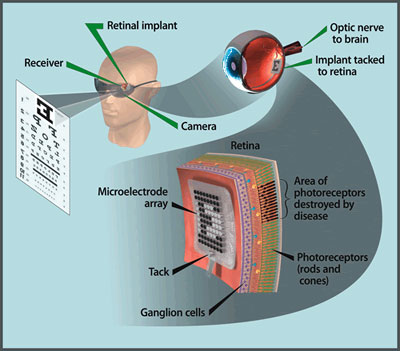
Normal vision begins when light enters and moves through the eye to strike specialized photoreceptor (light-receiving) cells in the retina called rods and cones. These cells convert light signals to electric impulses that are sent to the optic nerve and the brain. Retinal diseases like age-related macular degeneration and retinitis pigmentosa destroy vision by annihilating these cells.
With the artificial retina device, a miniature camera mounted in eyeglasses captures images and wirelessly sends the information to a microprocessor (worn on a belt) that converts the data to an electronic signal and transmits it to a receiver on the eye. The receiver sends the signals through a tiny, thin cable to the microelectrode array, stimulating it to emit pulses. The artificial retina device thus bypasses defunct photoreceptor cells and transmits electrical signals directly to the retina’s remaining viable cells. The pulses travel to the optic nerve and, ultimately, to the brain, which perceives patterns of light and dark spots corresponding to the electrodes stimulated. Patients learn to interpret these visual patterns.