A newer version of the platform is available. Please refresh the page.
Sign Up to Get information about Sales & Events Click Here

A newer version of the platform is available. Please refresh the page.
Posted by permission of Dr. Thomas O’Connor. Copyright by T. O’Connor.
“A hostile witness to the inhumanity of the human condition.” Leon Golub
Physical attack or assault resulting in death or physical injuryof an employee in a place of business is the standard definition of workplaceviolence (a topic that attracted national attention in 1987), but victimologistshave argued strongly that psychological and verbal abuse ought to be included inthis definition. The National Institute for Occupational Safety and Health(NIOSH) therefore defined workplace violence in 1991 as any physical assault,threatening behavior or verbal abuse occurring in the work setting. Theseviolent acts include homicide, forcible sex offenses, kidnapping, assault,robbery, menacing, reckless endangerment, harassment, disorderly conduct,berating language, physical or verbal threats or vandalism of personalproperty.About the only thing that is not included (and sometimes is) in the definition ofworkplace violence is terrorism.
Each year, at least 1,000,000 people are victimsof workplace violence, and about 1,000 of these cases are homicides. Accurate numbers are hard to come by since at least50% of the more minor incidents go unreported and there are other reportingproblems. In some states, more people die from being murdered at work thanin traffic accidents. Homicide is the second leading cause ofdeath for most retail, industrial, and office jobs, accountingfor 17% of all injuries, and females are three times as likely tobe murdered than males. Homicide is the first leading causeof death for people who work in mobile occupations which come in contactwith unstable or volatile persons, such as taxicab drivers, health care workers,social service, school or criminal justice settings, and males are three timesmore likely to be the victim of homicide. Homicide in the retail domainis often associated with robbery or attempted robbery, where resistance increases the risk of violence about 50percent. Homicide in other domains is more likely to involve the unexpected presence of someone who is not supposed to be at acertain place. Most workplace violence incidents involve persons known toeach other, and no place or occupation is immune from violence.
The following are the domains (places) whereworkplace violence occurs, and the relative frequency of occurrences based onanalysis of Labor Department statistics:
| Taxi Driving | 23% |
| Tavern/Liquor stores | 19% |
| Convenience stores | 17% |
| Fast food restaurants | 12% |
| Health care facilities | 10% |
| Business offices | 6% |
| Government offices | 5% |
| Police work | 4% |
| Post office | 3% |
| School | 1% |
Source: O’Connor (1997)
Victims of workplace violence are most likely to be 25-44 yearsof age, white (75%), slain with a firearm (80%), and come from a middle-sizedcity (population: 80,000-500,000). Gender depends upon the domain. Perpetrators are most likely to be 30-60 years of age, a middle class white male(97%) employees (41%), ex-employees (46%), or domestic partners of an employeeor a client (13%), familiar or comfortable with firearms, intent onrevenge, lethal in his intentions, and quite capable of murdering severalindividuals in the short course of his crime. In addition, the perpetrator willsometimes kill randomly and take his own life at the crime scene or somewhere inthe proximity. The attack is often well-planned, and interestingly enough,well-telegraphed by the perpetrator long before the incident, but some sort of denial,ignorance, or dismissal takes place among supervisors and coworkers whodownplay the significance of warning signs. In some cases, the perpetratoris a model employee, but most often they are disgruntled. Nearly 100% of fatalworkplace violence is acquaintance crime.
Nonfatal assaults are more scientifically researched thanhomicides. Precious little data exists on workplace homicides other thannews media reporting (which may be distorted). Each year, approximately500,000 employees need an average of five days off work to recover fromnonfatal assaults, totaling $55 million in lost wages and productivity. The mostcommon forms of nonfatal assault are (in descending order): unarmed physicalattack, shooting, stabbing, and rape. Attackers typically include co-workers, ex-employees, customers, visitors,relatives, and robbers. 60% of nonfatal workplace violence involvesacquaintances or persons known to the victim, and 40% are attacked by strangers.
CATEGORIZATION EFFORTS
There have been numerous efforts to categorize or classify the types ofworkplace violence. Incidents are typically divided into categories based on relationshipbetween the assailant and the victim or workplace:
OSHA offices also categorize incidents based on relationship, type ofoccupation, and relative risk. Their typology is notintended to be mutually exclusive, however:
Other categorization efforts look at the motivationbehind the crime, and sometimes the target of the violence:
UNDERSTANDING WORKPLACE VIOLENCE:
HARASSMENT/OBSESSION IN FAST FOOD JOBS
One of the things we know about workplace violence is thefact that it’s tied into a complex web of relationship expectations that arebuilt up along certain cultural expectations about the meaning of work.Restaurants are typically the kinds of places where we meet people. Customersexpect to be able to chat with other customers, and they expect the employees toprovide some kind of “atmosphere” that reflects the personalities ofthe workers. Customers also expect good service, value for their money,and to get it quick. The fast-food industry generally consists of low-end,low-wage, time-consuming, stressful jobs that are demeaning and degrading.Take a look at the people working behind the counter the next time you go intoone of these stores, and you’ll see that the personnel consist mainly ofeconomically exploited immature, pessimistic, angry teenagers who pay moreattention to the verbal banter going back and forth between coworkers than withcustomer service.
Fast food restaurants, like many other occupations, arebreeding grounds for harassment, specifically co-workerharassment. Most of it is nonsexual in nature,involving insults, barbs, or provocations traded back and forth between thecoworkers relating to who got the most drunk at last night’s house party, who’sgot the “hots” for whom, who drives the fastest car, who’s the biggestbrown nose with management, or who couldn’t operate a cash register if youtrained ’em for twenty years, etc. At this level of deskilled occupation,assignment becomes important, and some of the most devalued job assignments aredishwashing, stocking, taking out the garbage, and cleaning tables or parkinglots. Employees in these positions are the constant target of ridicule andharassment by other employees. Their anger consists of a perceived occupationalblockage in being labeled only capable of being a dishwasher, for example, forthe rest of their lives, perhaps being promoted to fry cook in a year ortwo. The other employees fantasize with futility over how their cooking orcashiering positions might possibly prepare them for careers as a chef or in theinformation economy. The fact is, however, that these are dead-end jobs.
In addition, management and supervision are typically lax,unskilled, and often part of the ongoing harassment dynamic. Females makeup an extraordinary number of fast food managers, and they have to deal withconstant come-ons, requests for time off, drunken/threatening behavior,tardiness, and absenteeism. Worker scheduling and discipline consumes atleast 50% of the manager’s time. Employees always have disputes andongoing grudges against their supervisors over hours scheduled (“She cut meback to 15 hours a week”), assignments (“She put me down to closeevery night this week”), and discipline (“You mean I’m fired just forcoming in five minutes late”). The turnover in personnel also supports thebringing in of fresh, psychologically unscreened, new applicants.
A second type of workplace violence resembles stalking andconsists of sexual obsession. Another one of the thingsabout the meaning of work in our society is, that like church and school, theworkplace is traditionally considered an appropriate place to find one’s lifepartner or spouse. Hence, unmarried employees (and even married onessometimes) look at their place of work as a pool of potential new boyfriends orgirlfriends. Culturally, part of the expectation is that it’s better tofind your mate at work than having picked him or her up in a bar or tavern, andthere are other expectations, both practical and impractical. Sexual obsessionis sometimes called love obsession or romantic stalking, and it occurs in atleast three varieties:
The spurned ex-lover or spouse whose primary motivation is revenge
The delusional erotomaniac who engages in bizarre, unrealistic fantasies
The pathological dependent who finds it difficult to function without the attention of another
The second type is a DSM IV subtype called delusionaldisorder, subtype erotomanic, and it’s not all that commonly diagnosed in casesof workplace violence because it requires the offender to believe that theirvictim is in love with them. Much more common are cases in which thevictim has clearly communicated something like “I wouldn’t go out with youif you were the last man on Earth”, and the offender simply refuses to giveup, and more closely fits the diagnosis of dependent personalitydisorder. The coworker relationship is more of a power strugglethan a romantic entanglement. This type of offender is much more likelythan the erotomaniac to write letters, make telephone calls, engage in giftgiving, and keep the victim under surveillance. Also, the erotomaniactries to keep their financial condition in order (so that they are worthy oftheir victim), while the dependent personality lets their finances and materialcondition deteriorate in a rapidly escalating pattern of attempts tomaintain some kind of relationship, any kind of relationship, even one where thevictims is constantly telling them to “get lost”. The wholepattern is similar to various other kinds of disorders, such as histrionic andborderline, where the person gets some kind of (presumably) sexual thrill out ofmaking advances that are constantly rejected. Victims will, of course,find it to be a very disturbing form of harassment, and at the risk ofpromulgating stereotypes that feminism hopes would be put to rest, almost everyplace of work in society has something similar in the form of an “officetease” or “looker”. It’s not so much the psychologicalcharacteristics of the parties involved, but the sociological role expectationspeople bring to work with them.
PSYCHOLOGICAL ABUSE IN THE WORKPLACE
The terms “psychological abuse or injury” refer toa legal convention known as “pain and suffering”. Generally,courts do not distinguish between the two with “pain and suffering”including physical pain, fright, nervousness, grief, worry, mortification,shock, humiliation, indignity, embarrassment, apprehension, terror, andordeal. In most cases, the abuse aggravates a pre-existing condition orprior susceptibility. Susceptibility by itself is no defense at law to aliability claim, and neither are pre-existing conditions which are degenerativeby nature, or only have their degenerative nature temporarily exacerbated.At law, abuse in the workplace must be shown to be greater than “life istough for everybody” and less than (but similar to) permanent physicaldeficits of an organic etiology with great practical consequences. Mostlegal arguments focus on “precipitate or triggering” events with legalcausation defined as anything understandable and credible (Frye standard).
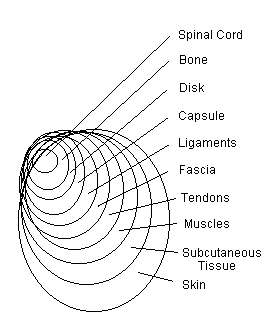
Collecting monetary damages for psychological abuse willoften require medical or expert proof of a “soft tissue” injury.Soft tissue is everything but the bone or vertebrae, and the pain is located inthe nerve endings. The victim’s complaints are regarded as subjective orpsychosomatic, but nonetheless real since soft tissue injuries don’t normallyresult in objective symptoms like swelling or bleeding. Soft tissueinjuries result, however, in scar tissue, which is permanent, and cannot befixed with surgery. The pain and suffering, in the form of severerestrictions on the victim’s range of motions, mobility, and resumption ofnormal activities, is permanent. Perhaps this diagram, commonly used asdemonstrative evidence, will provide an overview of how many layers of softtissue there are:
With numerous exceptions, negligent conduct which results inpsychological injury only is not actionable. Actually, the law is cleareron trauma caused to bystanders of workplace violence. Some courts, under a clearand convincing standard, have allowed recovery for emotional disturbances causedby witnessing injuries to a third party victim, but usually only when thebystander was in a “zone of danger”, had a specialrelationship to the victim (close friend or family member), or was undera legal duty to be cognizant of the victim’s safety. An example of legalduty would be such as a lifeguard’s responsibility for a drowningswimmer. Another legal doctrine is the theory of premisesliability, which considers whether the employer failed to exercisereasonable care in securing the premises (Lopez v. Rouse Co. 1994).
Some of the principles of vicarious liability can be used incriminal charges against an employer, not just in attempts to recover moneyawards under civil law. Workplace violence is one such area, and criminalcharges are appropriate if the offender commits an act of violence with theemployer’s actual or apparent authority. In addition, criminal penaltiesare possible for attempts to conceal “serious dangers” or anyfraudulent misrepresentation of safety and security. Under the respondeatsuperior doctrine, an employer can be held liable for injuries to otherscaused by an employee, but two conditions apply. First, the act of violence mustoccur within the course and scope of employment. This usually requiresthat the employee uses the employer’s equipment or is motivated by their jobduties. Secondly, the employer must have had knowledge that the employeeis violent but did nothing to correct the problem; thus, the forseeabilitystandard is applied. For example, an employer is liable if an employeereports sexual harassment, the employer does nothing, and the employee is laterattacked or injured.
Other forms of civil liability exist for employers. Negligenthiring is the term used to describe not doing an adequate backgroundcheck on an employee during the hiring process. Negligentsupervision refers to situations in which it cannot be known that theemployee had violent tendencies before hiring, but later develops them on thejob, and the employer fails to discharge or discipline the employee. Negligenttraining applies to jobs in which dangerous instruments or potentialweapons exist, and employees are not sufficiently trained on proper use of suchequipment.
The most common form of psychological abuse in the workplaceis supervisor bullying. Examples of this behavior includesyelling or screaming, use of derogatory names, the “silent treatment”,withholding of necessary information, aggressive eye contact, negative rumors,explosive outbursts of anger, and ridiculing someone in front of others.So-called “back-stabbing” coworkers also play apart in these behaviors. Perpetrators are typically suffering from narcissisticpersonality disorder, and display other symptoms indicative of a serial offender pattern.
WORKPLACE DISCRIMINATION
Discrimination in the workplace most commonly involvessexual, racial, or disabilities discrimination. Sexual harassment claims, ofwhich the most common forms are quid pro quo (an exchangeof sexual favors in return for keeping a job or getting a promotion), sometimesare considered in this category. Sexual discrimination can also take theform of unwelcome sexual advances or verbal comments of a sexual nature, inwhich case it constitutes a hostile work environment,however, this is the most common form of racial discrimination. TitleVII of the Civil Rights Act of 1964 is the area where claims of racism andsexism are made. In order to prove hostile work environment, a plaintiffmust show (1) unwelcome harassment; (2) based on race; (3) which is so severeand pervasive that it alters the conditions of employment and creates an abusiveatmosphere; and (4) some basis for imputing liability to the employer. Courtsuse a totality of circumstances test to see whether the actions were severe orpervasive enough to alter the conditions of employment or create an abusiveatmosphere. Congress has outlawed discrimination on the basis of “race, color,religion, sex, or national origin”, but it has not yet seen fit to include”sexual orientation”. A handful of states (Connecticut, Hawaii,Massachusetts, NJ, and Wisconsin) and cities (NY, LA, Chicago) do, however,protect sexual orientation or “affectional preference”, but employeeswho get fired on account of health reasons (AIDS or HIV) have to file disabilitydiscrimination suits. Gay and lesbians are not a protected class of people setup by the “equal protection” clause of the Constitution. Federalguidelines prohibit workplace discrimination on the supposed characteristics ofan entire class of people. So-called “glass walls” (jobassignment) and “glass ceilings” (lack of promotion) are contemporaryconcerns.
Gender, racial, and disabilitiesdiscrimination commonly involves various Civil Rights Acts that have been passedinto law in the United States, and some of these are as follows:
(1) The Civil Rights Act of 1866 – this one is enforced byprivate lawsuits only. It is Part 42 of the USC (United States Code), andthe subparts are referred to by Section (1981, 1982, 1983):
(a) 42 USC Section 1981 – deals withprivate employment. It allows the victim to sue for compensatory and punitivedamages if discriminated against by a private employer.
(b) 42 USC Section 1982 – deals with parks& playgrounds. It allows the victim to sue if they are discriminated againstby their neighbors while using sidewalks, common playground equipment, commonareas outside the curtilage, etc. It doesn’t come up much except in some gatedcommunity or homeowner association cases.
(c) 42 USC Section 1983 – deals withactions by government officials, and allows what are called “class actionsuits” by a victimized group in society.
(2) The Civil Rights Act of 1964 – this one is enforced bythe EEOC (Equal Employment Opportunity Commission), and their policy is to firstissue an injunction (stop) order before prosecution.
(a) Title II – deals with public accommodations.It lays out a laundry list of places (hotels, restaurants, gas stations,theatres, barber shops, taverns, health clubs, golf courses, swimming pools)were discrimination is not allowed. The victim must prove they were victimizedthrough clear and convincing evidence. It comes up a lot withso-called “private” clubs, and the courts have ruled that private mustnot simply be a for-profit organization. To be legally private, the club musthave self-governance and member-ownership.
(b) Title III – deals with statefacilities other than school and colleges. It’s mostly used to desegregateprisons and jails. Action must be initiated by the Attorney General of theState who is supposed to monitor these things.
(c) Title VI – deals with financialassistance programs, all federal aid, like AFDC, Student Grants/Loans, etc.It doesn’t apply to private banking programs.
(d) Title VII – deals with all matters ofemployment (hiring, firing, compensation, comparable worth, job transfer, etc.)It only applies to employers with 15 or more employees and engaged in interstatecommerce. This area of law has produced the distinction between “disparatetreatment” (individual victimization) and “disparate impact”(group victimization). Disparate treatment, to be proven, requires ashowing of intent (usually quid pro quo; intimidation, ridicule, an insult).Disparate impact, to be proven, requires a showing of statistics, and a socialscientific interpretation of those numbers. There are exceptions,however, in this area because something called BFOQ (Bona Fide OccupationalQualifier) allows employers to do a job audit and discriminate against peoplewho have, say, disabilities, if there is no way to make reasonable accommodationsfor them, or the job skills require discriminating.
(e) Title VIII (of the 1968 Civil RightsAct) – deals with real estate. It outlaws “refuse to rent” signs andpolicies as well as plain talk about what percentage of minorities mightlive/move in/move out of a neighborhood. To be proven, race must only beshown to be a significant factor, not a deciding factor.
Constitutionally, discrimination cases are tested by thecourt using one of three tests:
The Age Discrimination in Employment Act of 1967 protects workers age 45and above from various forms of blatant age discrimination,but subtle forms remain, such as downgrading job descriptions, lessenedexpectations of job performance, and newfound ways by management to put someone”out to pasture” such as “emeritus” status which has beenregularly used in academia for many years to push elderly college faculty out.
Victim trauma reactions vary in response to harassment, bullying, anddiscrimination. Suicide is quite common. Far more subtle, however,are behaviors that psychoanalysts refer to as regression— childlike drawing, doodling, scratching on desks, writing graffiti onwalls. Regression is a way of denying one has a need to be seen orheard. It eventually leads to anger, and then to work rage, where theworker may engage in sabotage or terrorism.
GOING “POSTAL”
Despite the headlines, relatively few workplace homicides involvestressed-out workers “going postal”, yet the news media promulgatesthis type of workplace violence as the norm. In all fairness, such eventsdo lend themselves well to sensationalism. Here’s a sample of somenotorious cases from 1986-1999.
In recent years, there’s been an interest in “profiling” thelethal employee. One of the first attempts to do so was by Anthony Baron(1993) which is a widely published checklist that says there’s a 90% probabilityof lethality if the offender has one or more of the following characteristics:
Kelleher (1997) offers a somewhat different checklist which finds thatcertain features, like impaired neurological functioning, are uncommon, and thatother features, like psychosis and personality disorders, are unknown. Themost common features are:
A history of violence is the most reliableindicator. Often, the lethal employee has been an angry person since they were ayoung man, and they usually have a tendency toward pathological blaming. Atriggering event can be any incident, however minor, butusually is a series of incidents that threaten the person’s ability tocope. A socially isolated individual will have livedalone for many years, recently changed job locations, or suffered a separationor divorce. The connection between social isolation and workplace homicideis strong. Romantic obsessions occur in a number ofvariations. Chemical dependence, or addiction, is assumedto be common. Depression is the most commonpsychological disorder in the United States, and between 7-15% of people with itact out violently at some point. Elevated frustration isexhibited by an unwillingness to work with others and (sometimes) harassmenttoward coworkers or suicide gestures. It generally takes a few yearsbefore the frustration becomes chronic enough to be called”elevated”. Kelleher calls the interest inweapons a “weapons fetish” and says they are preoccupied withweaponry or paramilitary subjects. Another strong indicator is a vocalization,or otherwise acting out, of violent intentions prior to committing a violentact. A final, often overlooked, indicator is that fellow employees areoften able to notice significant changes in behavior; hence, manifestations of strangeor bizarre behavior are anything that causes concerns to coworkers.
Workplace violence has become a breeding ground for litigationwherein victims seek compensation for injuries. Such victims have theburden of establishing that the violence and injuries were foreseeable and thatthe defendant’s conduct (their employer’s) was unreasonable. The 1991 statesupreme court case of Woodson v. Rowland (or the Woodson theory ofrecovery) puts forth a stringent burden in proving that the employer’s conductwas “substantially certain” to cause violent act or injury. Since moststate Worker’s Compensation programs prohibit recipients from suing theiremployers, victims who intend to sue cannot collect worker’s compensation. Themore creative approach is to sue parent corporations, security consultants,security services, employee assistance programs, or any entity that played arole or shares responsibility.
LITTLE OR NO CRIMINAL JUSTICE SYSTEM RESPONSE
Generally, the criminal justice system takes a “handsoff” approach to the problem of workplace violence. The area of study isinundated by contradictory research, numerous consultants, and news mediahounds. Federal law requires employers to provide a place of employment”free from recognizable hazards that are causing or likely to cause deathor serious harm to employees”. OSHA further requires the keeping ofOSHA Form 200 (Injury and Illness Log) and federal law also requires paperworkin the form of Workers’ Compensation claims. There are no requirements todocument employee complaints, incidents with supervisors, or reports ofsuspicious activities (these are referred to in industry jargon as”low-intensity conflicts or threats”).Victimologists also concur with the relative infrequency of at least a Type 3event, which are often called “rare events“.
The Postal Service has experimented with various predictiveinstruments, but so far, none have achieved much scientific validity andreliability. There are, however, numerous preventive checklists and riskassessment instruments. It’s unknown how well private business hasincorporated this knowledge into standard operating business practices.They tend to be little more than safety and security audits, or indicatorsof employee behavior needing supervisor intervention, and as an exampleinclude:
1. Persistent blaming or unwarranted criticism of coworkers,supervisors, or the organization
2. Unexplained, persistent mood changes
3. Evidence of depression or social withdrawal
4. Unprovoked outbursts of anger or aggression
5. Significant changes in work habits (tardiness, performance decline)
6. Evidence of substance or alcohol abuse
7. Refusal to follow work directives (work errors)
8. Bizarre or outlandish behavior in social get-togethers with coworkers
9. Argumentative, threatening, or combative behavior among coworkers
10. Persistent discussions that revolve around the subjects of weapons orhomicide
REFERENCES
Baron, A. (1993). Violence in the Workplace. Ventura, CA: Pathfinder.
Baron, A. & E. Wheeler. (1994). Violence in our Schools, Hospitals &Public Places. Ventura: Pathfinder.
Bowie, V., Fisher, B. & Cooper, C. (Eds.) (2005). Workplace Violence: Issues, Trends, Strategies. Portland, OR: Willan Publishing.
Campbell, R. (1995). Substance Abuse in the Workplace. Boca Raton: CRCPress.
Fox, J. & J. Levin. (1994). Overkill: Mass Murder & Serial KillingExposed. NY: Plenum.
Green, G. (1990). Occupational Crime. Chicago: Nelson-Hall.
Kelleher, M. (1996). New Arenas for Violence: Homicide in the AmericanWorkplace. Westport: Praeger.
Kelleher, M. (1997). Profiling the Lethal Employee: Case Studies of WorkplaceViolence. Westport: Praeger.
O’Connor, T. (1997). “Social Correlates of Workplace Violence” J. ofSecurity Administration 20(1):28-39.
Smigel, E. & H. Ross. (1970). Crimes Against Bureaucracy. NY: VanNostrand Reinhold.
Waddington, P., Badger, D. & Bull, R. (2005). The Violent Workplace. Portland, OR: Willan Publishing.