A newer version of the platform is available. Please refresh the page.
Sign Up to Get information about Sales & Events Click Here

A newer version of the platform is available. Please refresh the page.
Retrieved from http://aidshistory.nih.gov/tip_of_the_iceberg/index.html
 In the early 1980s, the era of infectious diseases was over, many people believed. Hadn’t modern medicine conquered scourges such as tuberculosis and polio with antibiotics and vaccines? Legionnaire’s disease and toxic shock syndrome caused brief scares in the 1970s, but they were quickly brought under control. Ironically, just as the awareness of AIDS was dawning, Dr. Richard Krause, then director of the National Institute of Allergy and Infectious Diseases, challenged the fallacy of this thinking in his book titled The Restless Tide:The Persistent Challenge of the Microbial World. By the summer of 1982, scientists had convincing evidence that AIDS must be caused by a blood-borne and sexually transmitted virus. That meant it affected people’s most private experiences. By the fall of 1984, not only had a retrovirus been identified as the cause of AIDS, it also had been shown to have properties that would make it very difficult, if not impossible, to make a conventional vaccine against AIDS. As reports of AIDS also arrived from other parts of the world—Africa, Haiti, Europe, and Asia— Dr. Thomas C. Quinn of NIAID and others visited these areas and began conducting research. They returned to the United States sounding warning bells of what the epidemic could become. Meanwhile, physicians were learning that the period between infection and the onset of AIDS symptoms could be 10 years or more. The accumulating evidence was sobering: all of it pointed to the formation of a gigantic iceberg of global disease, only the tip of which was then visible.
 |
|
|
|
|
|
 |
|
||||
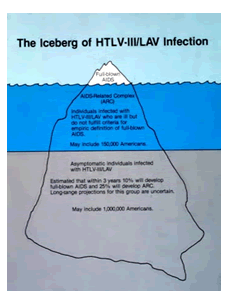 |
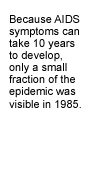 |
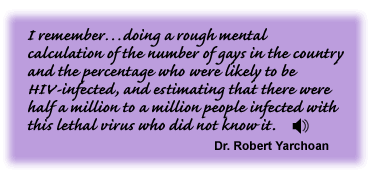 |
|
||
 |
|
||||
![So my paper about heterosexual spread in STD clinics in the United States…came out about the same time [1988] that Cosmopolitan came out with their front cover saying, “Women, you do not need to worry. You can’t get AIDS.” Dr. Thomas C. Quinn - link to sound track](https://zur-institute.sfo3.digitaloceanspaces.com/migrated/online/img/quinn.gif) |
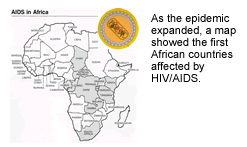 |
|
|||
 |
 |
|
|||