A newer version of the platform is available. Please refresh the page.
Sign Up to Get information about Sales & Events Click Here

A newer version of the platform is available. Please refresh the page.
Updated July 16, 2013
Wedding Bells Ring Again for Same-Sex Couples in California
On June 28, 2013, two days after the U.S. Supreme Court ruled that the petitioners of Prop 8 did not have legal standing to contest a lower court ruling that states that Prop 8 was unconstitutionality, California Governor Jerry Brown and State Attorney General Kamala Harris ordered county clerks around the country to begin issuing marriage licenses to same-sex couples. California which was once the second state to issue marriage licenses to same-sex couples, is now the thirteenth.
Minnesota Becomes 12th State to Allow Same-Sex Marriage
On May 14, Governor Mark Dayton signed legislation passed by the Minnesota legislature in the past week to authorize marriages between same-sex couples. The law takes effect Aug.1, 2013. Minnesota became the 12th state along with Washington, D.C., to pass laws allowing same-sex marriage. Delaware and Rhode Island also passed laws in the 2013 sessions. Thirty-six other states have constitutional provisions or state laws defining marriage as a relationship between a man and a woman. The Illinois legislature is actively considering legislation that would authorize same-sex marriage.
Quick facts on key provisions
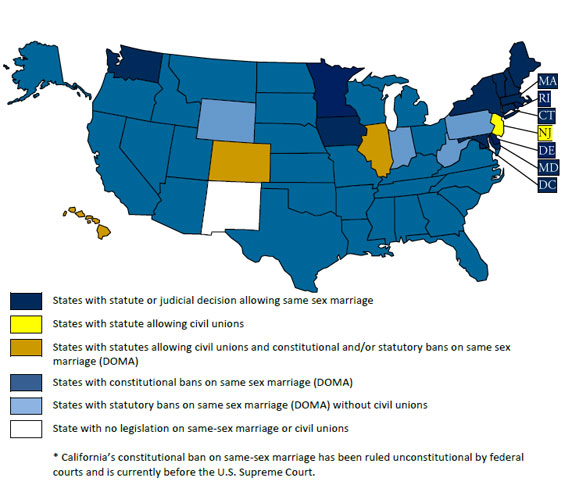
State law and/or constitutional provision limits marriage to relationships between a man and a woman (30 states with constitutional provisions and a further seven states with statutory provisions):
Alabama, Alaska, Arizona, Arkansas, Colorado, Florida, Georgia, Hawaii, Idaho, Illinois, Indiana, Kansas, Kentucky, Louisiana, Michigan, Mississippi, Missouri, Montana, Nebraska, Nevada, North Carolina, North Dakota, Ohio, Oklahoma, Oregon, Pennsylvania, South Carolina, South Dakota, Tennessee, Texas, Utah, Virginia, West Virginia, Wisconsin, Wyoming
* California voters adopted a constitutional provision limiting marriage to relationships between a man and a woman in November 2008. This provision was challenged in federal court and ruled unconstitutional. Same-sex couples became able to marry again in June 2013.
State issues marriage licenses to same-sex couples (13 states and D.C.):
California, Connecticut, Delaware, Iowa, Maine, Maryland, Massachusetts, Minnesota, New Hampshire, New York, Rhode Island, Vermont, Washington and the District of Columbia
* Rhode Island, Delaware and Minnesota passed same-sex marriage legislation in 2013. Rhode Island and Minnesota’s laws takes effect on Aug. 1 and Delaware’s took effect on July 1.
State allows civil unions, providing state-level spousal rights to same-sex couples (Six states):
Colorado, Delaware*, Hawaii, Illinois, New Jersey, Rhode Island.*
* Civil unions are no longer available in Delaware as of July 1 or Rhode Island on August 1, when the states’ same-sex marriage laws take effect.
Three of these states – Colorado, Hawaii and Illinois – also have statutes or constitutional provisions limiting marriage to relationships between a man and a woman.
Note: In Connecticut, New Hampshire and Vermont, same-sex marriage has replaced civil unions.
State grants nearly all state-level spousal rights to unmarried couples (domestic partnerships)* (Four states):
California, Nevada, Oregon, Washington**
**Effective June 30, 2014, domestic partnerships in Washington will be limited to couples who are 62 years of age or older.
State provides some state-level spousal rights to unmarried couples (domestic partnerships)*:
Hawaii, Maine, Wisconsin and the District of Columbia
*Please note that these state rights are broadly available in the state and not limited to a particular subgroup. For example, some states provide certain benefits to domestic partners who are state employees. These states are not included in this summary.
State Defense of Marriage Acts and Same-Sex Marriage Laws
History and Overview
State legislatures have been deeply involved in the public debates about how to define marriage and whether the official recognition of “marriage” should be limited to relationships involving one man and one woman or that same-sex couples should also be entitled to “marriage.” State legislatures have gone both ways in this debate: either enacting “defense of marriage” laws and constitutional provisions or, going the opposite direction, adopting laws allowing same sex marriage. Six states have adopted civil unions for same-sex couples that provide the same legal rights as marriage.
Most states have adopted prohibitions of same-sex marriage. Most states do so by adopting “defense of marriage” language that defines marriage in their state constitution and/or state law in a way similar to the language in the federal Defense of Marriage Act (DOMA) —”the word ‘marriage’ means only a legal union between one man and one woman as husband and wife.” Other states prohibit same sex marriages or marriages between persons of the same sex or gender. Thirty states have placed that language in their state constitutions (26 of these states also have statutory provisions adopting this language). A further seven states have statutory language adopting the restrictive language. Note that this count does include California, where federal courts have invalidated a 2008 initiative that added constitutional language defining marriage as limited to unions involving one man and one woman. The challenge to that constitutional provision is to be heard by the U.S. Supreme Court in 2013.
Thirteen states and the District of Columbia currently allow same-sex marriages. In Massachusetts, Connecticut, and Iowa, the states’ highest courts ruled that the state constitution required that same-sex couples be accorded the same marriage rights as opposite-sex couples. In Vermont, New Hampshire, the District of Columbia, New York, Maryland, Washington, Rhode Island and Delaware legislative bodies have passed statutory changes that allow same-sex marriages. In Maine, the legislature passed a same-sex marriage law in 2009, which was repealed in a voter referendum. In 2012, Maine voters reversed course and approved a same-sex marriage statute. Same-sex marriages are currently being performed in nine of those states. Rhode Island’s law takes effect Aug. 1 and Delaware’s law on July 1.
Several states have also expanded the legal rights available to spouses in same-sex relationships while also limiting marriage to opposite-sex couples with civil unions and domestic partnerships.