By Barbara Cox, Ph.D.
Table Of Contents:
- Overview and Basic Terms
- Definitions
- Stress
- Stressor
- Stress Response
- Neuron
- Endocrine
- Autonomic Nervous System (ANS)
- The Stress Response
- Review
- Diagram of the Stress Response
- Characteristics of Stress
- Controllability
- Predictability
- Appraisal
- Primary appraisal
- Secondary appraisal
- Perception of change
- Generation of internal conflicts
- Benefits of Stress
- Treatments for Stress
- Bibliography
Overview and Basic Terms
- Definitions
- Stress
Stress, according to the Mind/Body Medical Institute’s stress management website (MBMI.org), is a general term used to define the body’s automatic physiologic reaction to circumstances that require behavioral adjustments. Confronted by a threat – physical or emotional, real or imagined – the hypothalamus causes the pituitary gland and adrenal gland to release the neurotransmittors epinephrine and norepinephrine (also known as adrenaline and noradrenaline) and other related hormones. When released into the body, these messengers propel you into a state of arousal (your metabolism, heart rate, blood pressure, breathing rate and muscle tension all increase). This is commonly known as the fight-or-flight response, as named by Walter B. Cannon, M.D., of the Harvard Medical School. Note that this term is used for the general physiologic process and is therefore not a specific DSM diagnosis, although chronic stress can of course lead to the developmental of various mental illnesses.
In this article, we will use the following two terms to separate the events that trigger stress from our response to those events.
- Stressor
Stressor = Events that are perceived as endangering one physical or mental well-being. Stressors can include traumatic events, major life changes such as changing jobs or getting married, internal conflicts between competing goals, and minor daily hassles, such as being stuck in a traffic jam.
- Stress Response
Stress Response = a person’s response to a stressor.
- Neuron
Neuron = A nerve cell, the basic unit of the nervous system.
- Endocrine
Endocrine = glands that are ductless and their hormone secretions are distributed throughout our body by the bloodstream.
- Autonomic Nervous System (ANS)
Autonomic Nervous System (ANS) = a major division of the nervous system with two major subdivisions, the Sympathetic Nervous System (SNS), which serves an activating function to mobilize an organism to protect itself, and the Parasympathetic Nervous System (PNS), which serves to return the body to a restful, regenerative state.
The Stress Response
- Review
Physiologically, the stress response occurs along three primary axes; the neuronal axis, the neuroendocrine axis, and the endocrine axis (Parker, 1995). The neuronal axis primarily involves the Sympathetic branch of the Autonomic Nervous System (ANS). The Sympathetic Nervous System (SNS) uses the neurotransmitter epinephrine, along with other neurotransmitters, to activate the nervous system and target organs for immediate response by the person to a stressor. The second axis, the neuroendocrine axis, involves the SNS working in conjunction with the adrenal medulla, which is an endocrine organ. This results in the release of norepinephrine and epinephrine to help us mobilize energy for immediate stress response. Lastly, the endocrine axis involves several hormones that signal the adrenal cortex to release glucocorticoids such as cortisol. These hormones have the most prolonged effects on our physical system. Hans Selye (1946) called the coordinated set of responses to stress the General Adaptation Syndrome:
- First phase is alarm in which the body triggers the SNS to mobilize resources.
- Second phase is resistance in which we try to cope with threat by the fight-or-flight response.
- Third phase is exhaustion in which our body has depleted physiologic resources.
Chronic arousal can make us susceptible to illness. Seyle found that his lab animals that were exposed to chronic stress, regardless of the type of stressor, had enlarged adrenal glands, shrunken lymph nodes and stomach ulcers.
- Diagram of the Stress Response
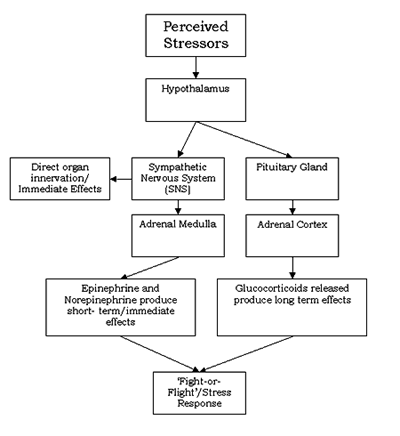
The stress response causes the following physiologic actions:
- Dilated Pupils
- Tense Muscles
- Liver releases glucose to fuel muscles
- Hormones are released that convert fats and proteins into glucose for muscle fuel
- Heart rate increases
- Blood pressure increases
- Respiration increases
- Digestion is slowed
- Less saliva released which causes dry mouth
- Spleen releases more red blood cells to carry oxygen
For a more in-depth discussion of the basic physiology of the stress response, please refer to Atkinson & Hilgard’s Introduction to Psychology (2003), especially pages 493 to 525.
- Characteristics of Stress
An event is perceived as stressful depending on these main characteristics:
- Controllability – the degree to which we can stop a stressor or bring it about. Studies have shown that the more uncontrollable a stressor is perceived to be, this increases the perception of stress and vice versa if a stressor is perceived as more controllable (Geer and Maisel, 1973).
- Predictability – if we can’t control something but can predict it, this usually decreases the severity of the stress response. In several studies, we tend to choose predictable shock over unpredictable shocks. (Abbott, Schoen, and Badia, 1984; Kartz and Wykes, 1985).
- Appraisal of the challenge to a person’s abilities and self-concept. Most stressors are ‘psychogenic’, meaning they arise based on the psychological interpretation or appraisal placed upon an event. This process of appraisal has been described by Lazarus and Folkman (1984) and they have identified two subtypes of appraisal:
- Primary appraisal – Primary appraisalhas to do with the initial judgment of whether a stressor has the potential for producing harm or loss. If no potential harm or loss is perceived than the stress response is not invoked.
- Secondary appraisal – If the primary appraisal does include potential for harm or loss, then secondary appraisaloccurs, which is the judgment whether sufficient resources are there to cope with the stressor. If the person feels they have sufficient resources, then the stress response is lowered.
- Perception of change – Causes a major changein life circumstance: The Life Events Scale was developed by Holmes and Rahe (1967) as a means to measure the impact of life changes. The scale ranks life events from most stressful to least stressful. This scale is one widely regarded scale to measure the impact of life events, but it also has been criticized for many reasons. The scale includes both positive (i.e., marriage) and negative changes (i.e., job loss), but most research shows that negative events have a greater impact on physical and mental health. The scale also assumes that all people respond to a given event the same way, but there are large individual differences in response to a given event. Furthermore, different people can view the same events as either stressors or challenges, depending on characteristics such as attributional style and stress hardiness.
- Generation of internal conflicts – This can cause stress when a person has to choose between two conflicting or mutually exclusive goals. This can occur, for example, when an individual goal conflicts with a family goal or a societal/cultural standard.
Benefits of Stress
Under certain circumstances, stress can be beneficial. Robert M. Yerkes, M.D. and John D. Dodson, M.D. first described the relation between stress and performance in 1908. “At appropriate levels, acute stress increases both efficiency and performance. For example, before an athletic event, competitors involuntarily elicit the stress response. Before an examination, students exhibit increased heart rate and blood pressure. Similarly, in today’s high-powered competitive environment, the stimulus of the stress response is often essential to success in some settings”. (https://www.mbmi.org/pages/mbb_s2.asp) As stress increases, so do performance and efficiency.
However, this relationship does not continue indefinitely in this fashion. When too many situations demand adjustment, stress exceeds a threshold. This stress overload contributes to diminishing performance, efficiency, and even health. This relationship is known as the Yerkes-Dodson Law.
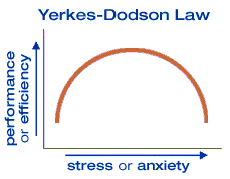
From “Mind/Body Basics: Stress and Performance,” by the Mind/Body Medical Institute, https://www.mbmi.org/pages/mbb_s2.asp. Reprinted with permission.
Treatments for Stress
The subsequent article is going to focus on treatments that will lessen the mental and physical effects of chronic stress on a variety of clients. The techniques discussed will target and lessen symptoms such as anxiety and physical reactions such as increased respiration rate, increased heart rate, muscle tension, increased blood pressure, pupil dilation, and overproduction of stress hormones. Our aim as therapists will be multi-faceted: to assess the client’s perceived stressors and assist them in modifying attitudes about the stressors; to lessen chronic overarousal of the SNS and instead invoke the regenerative properties of the PNS; and finally, to assist them in accessing personal strengths and resources that buffer against stress, such as social support and stress hardiness.
References
Abbott, B. B., Schoen, L.S., & Badia, P. (1984). Predictable and unpredictable shock: Behavioral measures of aversion and physiological measures of stress. Psychological Bulletin, 96, 45-71.
Geer, J.H. & Maisel, E. (1973). Evaluating the effects of the prediction-control confound. Journal of Personality and Social Psychology, 23, 314-319.
Holmes, T.H. & Rahe, R.H. (1967). The Social Readjustment Rating Scale. Journal of Psychosomatic Research, 11, 2, 213-218.
Kartz, R. & Wykes, T. (1985). The psychological difference between temporally predictable and unpredictable stressful events: Evidence for information control theories. Journal of Personality and Social Psychology, 48, 781-790.
Lazarus, R.S. & Folkman, S. (1984). Stress, appraisal, and, coping. New York: Springer.
Parker, J.C. (1995). Stress management. In P.M. Nicassio & T.W. Smith (Eds). Managing Chronic Illness: A Biopsychosocial Perspective. Washington, D.C.: American Psychological Association.
Seyle, H. (1946). The general adaptation syndrome and diseases of adaptation. Journal of Clinical Endocrinology, 6, 117-230.
Smith, E.E., Nolen-Hoeksema, S., Fredrickson, B.L., Loftus, G.R., Bem, D. J. & Maren, S. (2003). Atkinson & Hilgard’s Introduction to Psychology. Belmont, CA: Thompson Wadsworth Inc.
Stress Management. Retrieved from https://www.mbmi.org/.
Yerkes, R.M., & Dodson, J.D. (1908). The relation of strength of stimulus to rapidity of habit formation. Journal of Comparative and Neurological Psychology, 18, 459-482.
