A newer version of the platform is available. Please refresh the page.
Sign Up to Get information about Sales & Events Click Here

A newer version of the platform is available. Please refresh the page.
By Melissa Petrakis
Posted by permission of the antiTHESIS editor. Originally posted on antiTHESIS web site at https://www.english.unimelb.edu.au/postgraduate/ antithesis/forum2004/Petrakis.html. Copyright by antiTHESIS at the University of Melbourne Press.
Abstract:
While the last decade has seen suicide prevention and intervention receive considerable attention as a public health issue, commonwealth and state funding for clinical work has been discrete, project-based and time-limited. In 1993 more than 2,000 Australians died by suicide, an alarming unchanged statistic at 2001.
The Western AreaSuicide Prevention Strategy (WASPS) has worked with this client group through2003 and 2004. Burden of Disease-data indicates that the Western Region has thehighest rate in Victoria of Years Living with a Disability for all mentaldisorders for both men and women; a significant burden. The number of GeneralPractitioners relative to population is among the lowest in Victoria at one toevery 1,062-1,353 people. There is limited specialist Psychiatry, counselling,psychosocial rehabilitation, social support or material aid.
The reality ofthis situation is one of considerable risk: risk to clients, due to level ofvulnerability and limited resources available, and risk to cliniciansattempting to fill system gaps and somehow ensure client mental stability andpersonal security. Clinician risk is present in the inexact science of riskassessment, dual responsibilities of duty of care and client rights to confidentialityand self-determination, and in managing trauma and personal stress.
**********
The last decade has seen suicide preventionand intervention receive considerable attention as a public health issue. In1993 suicide was the recorded cause of death for 2,081 Australians. Despite tenyears of a National Suicide Prevention Strategy the number of Australians whodied by intentional self-harm was still over 2,000 at 2,454 by 2001[i]. Internationally such numbersare a grave concern, as is the rise in raw numbers of suicides in westernnations across the last decade. Reporting is often anxiety provoking, forexample the British statistic that ‘In England somebody takes their own lifeevery two hours’[ii].
Following a self-harm or suicide attempttreatment in hospital is common. A Commonwealth investigation into assessmentand follow-up of suicidal clients found that hospitals utilise a range ofsystems for undertaking assessment. Access to appropriate staff at the righttime is often seen as problematic, with access to Crisis Assessment andTreatment Team (CATT) staff to assess the ‘at risk’ nature of people uponpresentation often quite patchy, particularly if the CATT is not situated focusto that provided by ED or crisis liaison officers[iii]. This is due to limitedresources in each region, large size of CATT regions, and minimal overnight andweekend coverage.
Lack of a ‘gold standard’ for follow-up
Community-based follow-up of the client iscrucial yet is also the weakest element in the system[iv]. As there is currently no’gold standard’ of empirically supported best practice, no consistent approachis used, the result being that responsibility for follow-up becomes blurred andthe process is often overlooked. It has been noted that what is required is’old fashioned social work casework’ of a reasonable duration. Further,community-based health providers no longer offer enough of this follow-up,especially the NGOs which tend to use a different paradigm. The waiting timesfor clients to see community agencies was also seen as inappropriately long anda major barrier[v].The Western Area Suicide Prevention Strategy (WASPS) has attempted to addressthese issues in Victoria’s west: through risk assessment; monitoring ofDepression; and assistance with resolution of issues exacerbating clientvulnerability, including housing, financial issues, legal issues, material aid,relationship difficulties, social support matters, employment, and generalhealth problems.
Individuals who present with self-harm andsuicide risk are referred to mental health services. Traditionally the responseof mental health services has consisted of risk assessment and management,followed by treatment interventions of medication or psychotherapy[vi]. There has, however, beenlittle empirical evidence to suggest that either medication orpsychotherapy-based interventions, as practiced, are effective in reducingsuicide risk when compared to a non-treatment control group[vii]. Research from the United States has noted that of the 30,000 people who complete suicide each year[viii], most have been in mentalhealth treatment and still more have seen their primary care provider recently[ix].
It has been noted in the research thatworking with clients presenting in therapy with suicidal thoughts or plans canbe challenging for even the most experienced therapist[x]. Indeed, suicide remains one ofthe most difficult therapeutic issues faced by therapists in their professionallifetime[xi].Clinicians vary in their comfort with discussing suicide and raising the issuewith clients whom they suspect might feel suicidal but are not talking about itexplicitly. Therapists often feel anxious, fearing that talking about suicidewill ‘put the thought into the client’s mind’, or feel that raising thedialogue might be ‘offensive or clumsy’[xii].It should be noted that there is no evidence that asking clients whether theyhave suicidal thoughts will put the thought into their mind if it was notalready there before. A detailed discussion with the client as to their suicidalfeelings and thoughts, and how they might react to them, places the therapistin a better position to make decisions about how best to respond. It may bethat they can continue to work within the boundaries of the confidentialtherapeutic relationship, or that discussing concerns with other people with orwithout the client’s consent is appropriate.
Although there are not yet statisticsavailable for nursing, studies have suggested that most nurses who treatpatients at risk of suicide will ‘probably have a patient who commits suicide’[xiii]. Surveys show thatapproximately 20-25% of psychiatrists have had patients die of suicide, withfigures higher when focusing on psychiatry residents[xiv]. Further, survey researchindicates that 15-25% of clinicians across various disciplines in health andallied health have had a patient die by suicide[xv]. There has been little andpatchy research into the impact on clinicians of client death, how they cope,and what contributes to coping such that clinicians are able to continue towork with this client group.
To try to ensure client safety between sessions and removethe risk of suicide from permeating every discussion, s ome therapists use what are called ‘no-harm’ contracts in their work[xvi]. These are agreements,written or verbal, in which the client gives a commitment not to act onsuicidal thoughts between sessions and to contact support services should theyfeel unable to manage suicidal thoughts any longer. Though these may be helpfulin some cases, it is worth a therapist considering whose needs are being servedby such contracts. It may be that they in fact hope to alleviate their own fearof somehow failing in their duty of care or that they are uncomfortable workingwith uncertainty; however, with this client group these two issues are aconstant possibility and a reality that is better not avoided. Kroll(2000), via a postal survey of clinicians, found that 41% of respondents hadtreated people who completed suicide or made another serious attempt afterentering into a no-suicide contract with the clinician. In contracting ‘therapistsshould reflect on whether a very distressed client is able to make such acommitment over a longer period’[xvii].
Confidentiality is a ‘fundamentalrequirement for keeping trust’[xviii].With a client at risk a therapist needs to utilise careful professionaljudgment about the balance between potential harm to the client of eitherdisclosing information or maintaining confidentiality.
A disclosure in the absence of a strongbelief that the client presents an immediate risk to themselves potentiallycreates a situation in which the therapist could be sued by the client forbreach of confidence[xix];however, failure to disclose when there is a strong belief that the clientpresents an immediate risk to themselves, if the client subsequently takestheir own life, may lead a therapist to having to defend themselves against theaccusation of failure in their duty of care[xx].
The experience of working with suicidalclients can prompt a range of responses, including fear, anger, sleeplessnessand a sense of professional incompetence[xxi].A review of the literature into professionals’ responses to patient death bysuicide reported similar emotions, though perhaps somewhat heightened: grief,guilt, self-blame, anger, fear, and self-doubt[xxii].Retrospective surveys of psychiatrists and psychologists note that the direct,traumatic experience of a patient suicide may lead to professional growth orleave a heavy and often long-lasting psychological burden[xxiii]. These professionals reportminimal education towards coping with a patient suicide[xxiv].
Research suggests that there may be a linkbetween working with suicidal clients and vicarious trauma[xxv]. Fox and Cooper (1998)identify several issues that are important for the therapist to consider whenreflecting on how working with suicidal clients affects them:
All these factors can inhibit thestrategies that might usually be used to support practice. For example, thefear of blame could inhibit the use of peer support from colleagues.
Increasingly therapists and clinicians areconcerned with the risk of litigation[xxvi].The risk of clients harming themselves can inhibit the therapist from actingcreatively and collaboratively, making their actions defensive and focused’solely on risk assessment rather than therapeutic change’[xxvii]. Understandably then, inan under-resourced system, focus shifts to at least keeping these clients safe.The focus shifts to risk assessment.
Risk assessment protocols as defence against anxiety
Risk assessment is an ‘inexact science’[xxviii] .Therapists are not able to consistently predict with any certainty how anindividual will react to difficult or changing circumstances. It is importantnot to self-impose unrealistic expectations of an ability to predict thefuture.
There appears tobe no one definition of risk that is universally held or accepted as a practicestandard. Definitions of risk appear to be very much determined by locallyaccepted practice wisdom rather than a prescribed understanding based onempirical evidence. For this reason this project will use the Risk Assessmenttable accepted by North Western Mental Health Services as our standard, therebyincorporating into the project consistency in assessment of risk (See Table below).
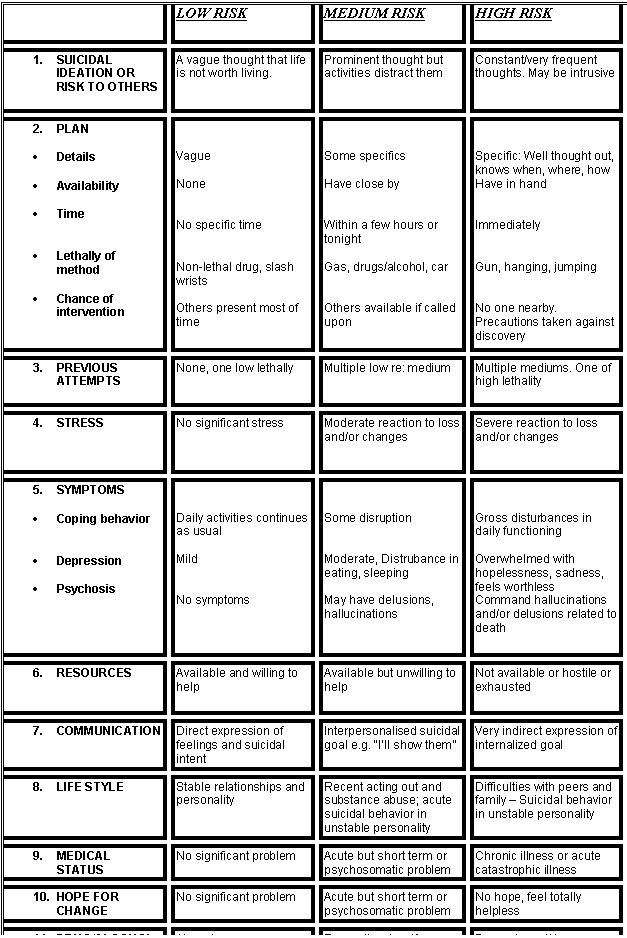
Assessmentof risk then is a matrix. The goal of a table such as this is to providestructure – a protocol – to assist clinicians to feel secure in theirdecision-making regarding level of intervention. To feel that they did whatanother rational and cautious professional would have done; that they didn’t missanything. It remains difficult however, as a client may present as low riskaccording to some criteria yet high risk according to others. They may have nospecific plan or timeframe for ending their life, for example, yet may beexperiencing a severe reaction to some recent loss, such as the end of arelationship or loss of employment. They may be self-medicating with alcohol.However it may be that they are open to help, and have a stable personality.Yet co-morbidity of depression or heart disease or chronic pain from a caraccident may complicate the picture. How at risk is this person of suicide, andhow intensive should our intervention be as a result?
Severity and chronicity of the client group
The belief has been raised that not allsuicidal clients are identified. Further, it has been the experience that manyof those that tend to slip through may be those who are more difficult to workwith or have more complex problems, including dual diagnosis, or lack ofongoing relationships or having no fixed abode or poor accommodation[xxix].
Co-morbidities of substance abuse,Depression and hopelessness elevate the risk of suicide. Depression is presentin as many as 70% of completed suicides[xxx];substance abuse and intoxication heighten risk – of those people who die bysuicide 25-50% consume alcohol prior to ending their lives. People who livealone, are divorced or separated, or are recently bereaved also have anelevated risk of suicide[xxxi].Further, sickness is a risk factor – of those people who die by suicide 25-70%had a debilitating medical illness present at the time of their death. Thosepeople who have suffered some form of abuse or neglect have a heightened riskof suicide[xxxii].The majority of both adolescents and adults who die by suicide (90%) met thecriteria for an associated psychiatric disorder at the time of their death[xxxiii].
Specific diagnoses in terms of psychopathology and psychiatric illness have been found to be associated with higher suicide risk. These are: depression; schizophrenia; alcohol/drug misuse;hopelessness; paranoia; mood disorders; psychosis; affective disorders, i.e.lack of affective control or where there is violence; anxiety/panic disorders;co-morbidity and Post Traumatic Stress Disorder (PTSD)[xxxiv]. Previous suicide attemptsand/or a family history of suicide are also associated with higher risk[xxxv].
We are at work in a domain of uncertainty.Working with such at risk clients involves considerable care burden onclinicians. Fear of imperfect responses, the gravity of the repercussions, asense of potential blame or litigation, and a questioning of one’s capacitiesare chronic and debilitating. There is considerable risk in working in the faceof the unpredictable, the inconsistently predictable, and the predictable foronly the time being.
Melissa is the Project Manager/Project Clinician conducting the Western Area Suicide Prevention Strategy Project (WASPS). The project has been running for 2 years. Melissa has previously worked in acute adult psychiatry as a Social Worker, and as a Program Manager for Richmond Fellowship of Victoria in Psychiatric Disability Rehabilitation and Support Services. She has expertise in individual and family counseling, crisis intervention, discharge planning, accommodation support, material aid, employment, recreation, financial & legal services, advocacy, self-help and community services. Melissa is a member of the teaching staff at the University of Melbourne School of Social Work, tutoring in the undergraduate program and guest lecturing on mental health.
REFERENCES
Australian Bureau of Statistics, Causes of Death. Australia, 3303.0. Canberra: 2001.
BACP, Ethical Framework for Good Practice in Counselling and Psychotherapy. Rugby, 2002.
Bond, T., Standards and Ethics for Therapy in Action. 2nd ed. London: Sage Publications, 2000.
Carr, A., Handbook of Clinical Psychology: a Contextual Approach. London: Routledge, 1999.
Commonwealth Department of Health and AgedCare, Background Paper To Funding Round On Effective Follow-Up Of Suicidal Clients Of Hospital Emergency Departments In Victoria. National SuicidePrevention Strategy Strategic Development Project – Victoria, July 2001.
Commonwealth Department of Human Servicesand Health, Youth Suicide in Australia: A Background Monograph. AustralianGovernment Publishing Service, 1995.
Daines, B.,Gask, L. & Usherwood, T., Medical and PsychiatricIssues for Therapists. London: Sage Publications, 1997.
Departmentof Health, NationalSuicide Prevention Strategy for England. London: HMSO, 2002.
Fox, R &Cooper, M., ‘The effects of suicide on the private therapist: A professionaland personal perspective,’ Clinical Social Work Journal 26 (1998):143-57.
Gitlin, M.J., ‘A psychiatrist’s reaction toa patient’s suicide,’ American Journal of Psychiatry 156 (1999):1630-1634.
Grad, O.T., Zavasnik, M.A. & Groleger,U., ‘Suicide of a patient: Gender differences in bereavement reactions oftherapists’, Suicide and Life Threatening Behaviour 27 (1997): 377-386.
Hawton, K. & Van Heeringen, K., The International Handbook of Suicide and Attempted Suicide. Chichester: JohnWiley, 2000.
Heard, H.L., ‘Psychotherapeutic approachesto suicidal ideation and behaviour,’ in K. Hawton & K. Van Heeringen (Eds),The International Handbook of Suicide and Attempted Suicide. Chichester: John Wiley, 2000.
Jenkins, R., Legal Issues in Therapy and Psychotherapy. London: Sage Publications, 2002.
Kleespies, P.M., Penk, W.E. & Forsyth,J.P., ‘The stress of patient suicidal behaviour during clinical training:Incidence, impact and recovery,’ Professional Psychology: Research and Practice 21 (1993): 257-263.
Kroll, J., ‘Use of no-suicide contracts bypsychiatrist in Minnesota,’ American Journal of Psychiatry, 157 (2000):1684-1686.
Mooecicki, E.K., ‘Epidemiology of suicide,’in D.G. Jacobs (Ed.), The Harvard Medical School guide to suicide assessment and intervention. San Francisco: Jossey-Bass (1999): 40-51.
New Zealand Guidelines Group, ‘Risk factorsfor Suicide,’ Assessment and Management of People at Risk of Suicide Appendix7, May 2003.
Reeves, A.,Bowl, R. & Wheeler, S., ‘Suicide Risk Factors Identified Through ResearchLiterature,’ Unpublished Research Report, University of Birmingham, 2003.
Reeves, A.& Mintz, R., ‘The Experience of Therapists Who Work with Suicidal Clients:An Exploratory Study,’ Counselling and PsychotherapyResearch Journal 2(2001): 37-42.
Reeves, A. & Seber, P., ‘Working withthe Suicidal Client,’ Counselling & Psychotherapy Journal 15, 4(2004): 45-50.
Richards,B.M., ‘Impact upon therapy and the therapist when working with suicidalpatients: some transference and countertransference aspects,’ British Journal of Guidance and Counselling 28 (2000): 325-37.
Rudd, M.D.,Jobes, D.A., Joiner, T.E. & King, C.A., ‘The outpatient treatment of suicidality:An integration of science and recognition of its limitations,’ Professional Psychology – Research and Practice 30 (1999): 437-46.
Ruddell, P.& Curwen, B., ‘Understanding Suicidal Ideation and Assessing for Risk,’ British Journal of Guidance and Counselling 30 (2002): 363-72.
Sharry, J., Darmody, M. & Madden, B.,’A solution-focused approach to working with clients who are suicidal,’ British Journal of Guidance & Counselling 30 (2002): 4.
Valente, S.M., ‘Psychotherapists’ reactionsto a patient’s suicide,’ American Journal of Orthopsychiatry 64 (1994):614-621.
Valente, S.M. & Saunders, J.M.,’Nurses’ Grief Reactions to a Patient’s Suicide,’ Perspectives in Psychiatric Care 38, 1 (Jan-Mar 2002): 5-14.
Verkes, R.J. & Cowen, P.J.,’Pharmacotherapy of suicidal ideation and behaviour,’ in K. Hawton & K. VanHeeringen (Eds), The International Handbook of Suicide and Attempted Suicide. Chichester: John Wiley, 2000: 9-29.
[i]Commonwealth Department of Human Servicesand Health, Youth Suicide in Australia: A Background Monograph.(Australian Government Publishing Service: 1995). Australian Bureau ofStatistics, Causes of Death. Australia, 3303.0. (Canberra: 2001).
[ii] Department of Health, NationalSuicide Prevention Strategy for England. (London: HMSO, 2002).
[iii]Commonwealth Department of Health and AgedCare, Background Paper To Funding Round On Effective Follow-Up Of Suicidal Clients Of Hospital Emergency Departments In Victoria. National SuicidePrevention Strategy Strategic Development Project – Victoria, July 2001.
[iv]Commonwealth Department of Health and AgedCare 2001.
[v]Commonwealth Department of Health and AgedCare 2001.
[vi]A. Carr, Handbook of Clinical Psychology: a Contextual Approach. (London: Routledge, 1999). K. Hawton& K. Van Heeringen, The International Handbook of Suicide and Attempted Suicide. (Chichester: John Wiley, 2000). J. Sharry,M. Darmody & B. Madden, ‘A solution-focused approach to working withclients who are suicidal,’ British Journal of Guidance & Counselling30 (2002): 4.
[vii]H.L. Heard, ‘Psychotherapeutic approachesto suicidal ideation and behaviour,’ in K. Hawton & K. Van Heeringen (Eds),The International Handbook of Suicide and Attempted Suicide. (Chichester: John Wiley, 2000). R.J. Verkes & P.J. Cowen, ‘Pharmacotherapy of suicidal ideationand behaviour,’ in K. Hawton & K. Van Heeringen (Eds).
[viii]E.K. Mooecicki, ‘Epidemiology of suicide,’in D.G. Jacobs (Ed.), The Harvard Medical School guide to suicide assessment and intervention (San Francisco: Jossey-Bass, 1999), 40-51.
[ix]M.J. Gitlin, ‘A psychiatrist’s reaction toa patient’s suicide,’ American Journal of Psychiatry 156 (1999):1630-1634.
[x] A. Reeves, R.Bowl & S. Wheeler, ‘Suicide Risk Factors Identified Through ResearchLiterature,’ Unpublished Research Report, University of Birmingham, 2003.
[xi] M.D. Rudd,D.A. Jobes, T.E. Joiner & C.A King, ‘The outpatient treatment ofsuicidality: An integration of science and recognition of its limitations,’ Professional Psychology -Research and Practice 30 (1999): 437-46.
[xii]Reeves and Seber, 2004.
[xiii]S.M. Valente & J.M. Saunders, ‘Nurses’Grief Reactions to a Patient’s Suicide,’ Perspectives in Psychiatric Care 38, 1 (Jan-Mar 2002): 5-14, 5.
[xiv]P.M. Kleespies, W.E. Penk & J.P.Forsyth, ‘The stress of patient suicidal behaviour during clinical training:Incidence, impact and recovery,’ Professional Psychology: Research and Practice 21 (1993): 257-263.
[xv]Valente, 1994.
[xvi]Reeves and Seber, 2004.
[xvii]Reeves and Seber, 2004.
[xviii]BACP, Ethical Framework for GoodPractice in Counselling and Psychotherapy. (Rugby, 2002).
[xix]T. Bond, Standards and Ethics forTherapy in Action. 2nd ed. (London: Sage Publications, 2000).
[xx]B. Daines, L.Gask & T. Usherwood, Medical and Psychiatric Issues for Therapists. (London:Sage Publications, 1997). R. Jenkins, Legal Issues in Therapy and Psychotherapy.(London: Sage Publications, 2002).
[xxi]A. Reeves& R. Mintz, ‘The Experience of Therapists Who Work with Suicidal Clients:An Exploratory Study,’ Counselling and Psychotherapy Research Journal 2 (2001):37-42. B.M. Richards, ‘Impact upon therapy and the therapist when working withsuicidal patients: some transference and countertransference aspects,’ British Journal of Guidance andCounselling 28 (2000): 325-37.
[xxii]Valente and Saunders, 2002: 5
[xxiii]O.T. Grad, M.A. Zavasnik & U. Groleger,’Suicide of a patient: Gender differences in bereavement reactions oftherapists’, Suicide and Life Threatening Behaviour 27 (1997): 377-386.
[xxiv]Kleespies, Penk and Forsyth, 1993.
[xxv] R. Fox & M. Cooper, ‘The effects of suicide on theprivate therapist: A professional and personal perspective,’ ClinicalSocial Work Journal 26 (1998):143-57.
[xxvi]Reeves and Seber, 2004
[xxvii]J. Sharry, M. Darmody & B.Madden, ‘A solution-focused approach to working with clients who are suicidal,’British Journal of Guidance & Counselling 30 (2002): 4.
[xxviii]Reeves and Seber, 2004.
[xxix]Commonwealth Department of Health and AgedCare, 2001.
[xxx]New Zealand Guidelines Group, ‘Risk factorsfor Suicide,’ Assessment and Management of People at Risk of SuicideAppendix 7, May 2003.
[xxxi]New Zealand Guidelines Group, 2003; Reeves and Seber, 2004.
[xxxii]New Zealand Guidelines Group, 2003; A. Reeves, R. Bowl & S. Wheeler,’Suicide Risk Factors Identified Through Research Literature,’ UnpublishedResearch Report, University of Birmingham, 2003; Reeves and Seber, 2004; P. Ruddell & B. Curwen, ‘Understanding Suicidal Ideation and Assessingfor Risk,’ British Journal of Guidance and Counselling 30 (2002): 363-72.
[xxxiii]New Zealand Guidelines Group, 2003.
[xxxiv]Reeves, Bowl and Wheeler, 2003;Reeves and Seber, 2004; Ruddell and Curwen, 2002.
[xxxv]Reeves and Seber, 2004.